
Memory Care Costs in Bellingham: What Whatcom County Families Should Know
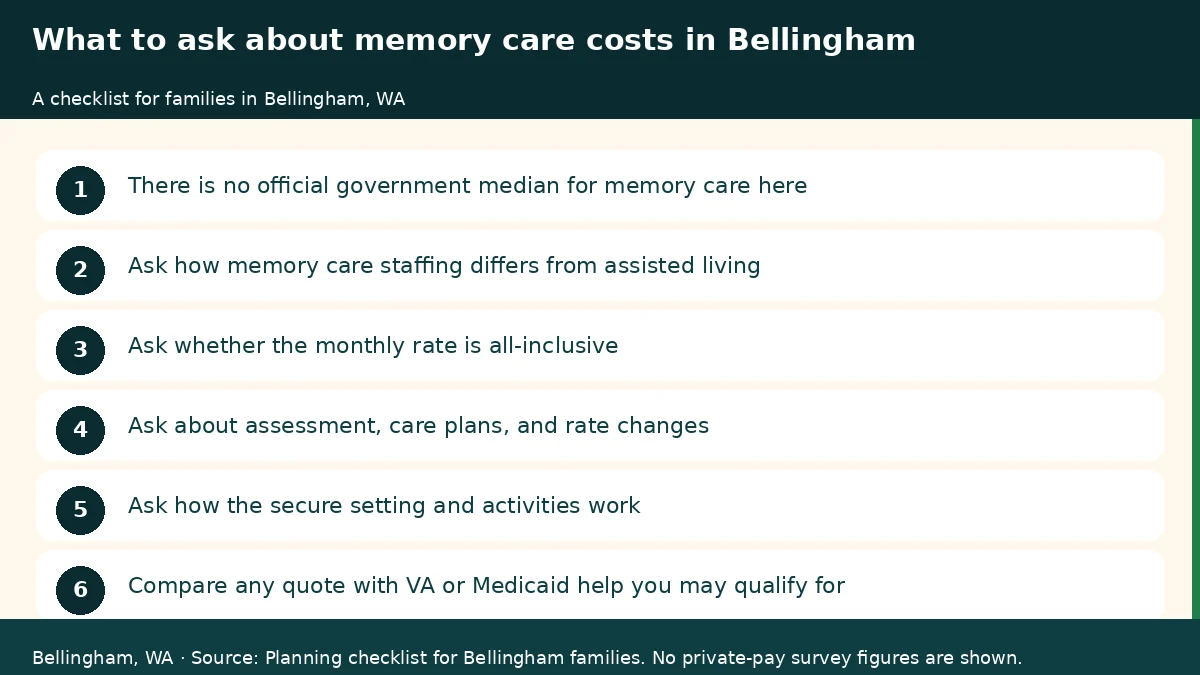
There is no official federal or Washington survey that publishes a private-pay median for memory care in Bellingham. Memory care is usually priced higher than standard assisted living because of staffing, training, and a more structured setting, but the only reliable figure is a written quote.
Medicare does not pay for room, board, or ongoing custodial care in assisted living if that is the only care someone needs (Medicare.gov: long-term care coverage).
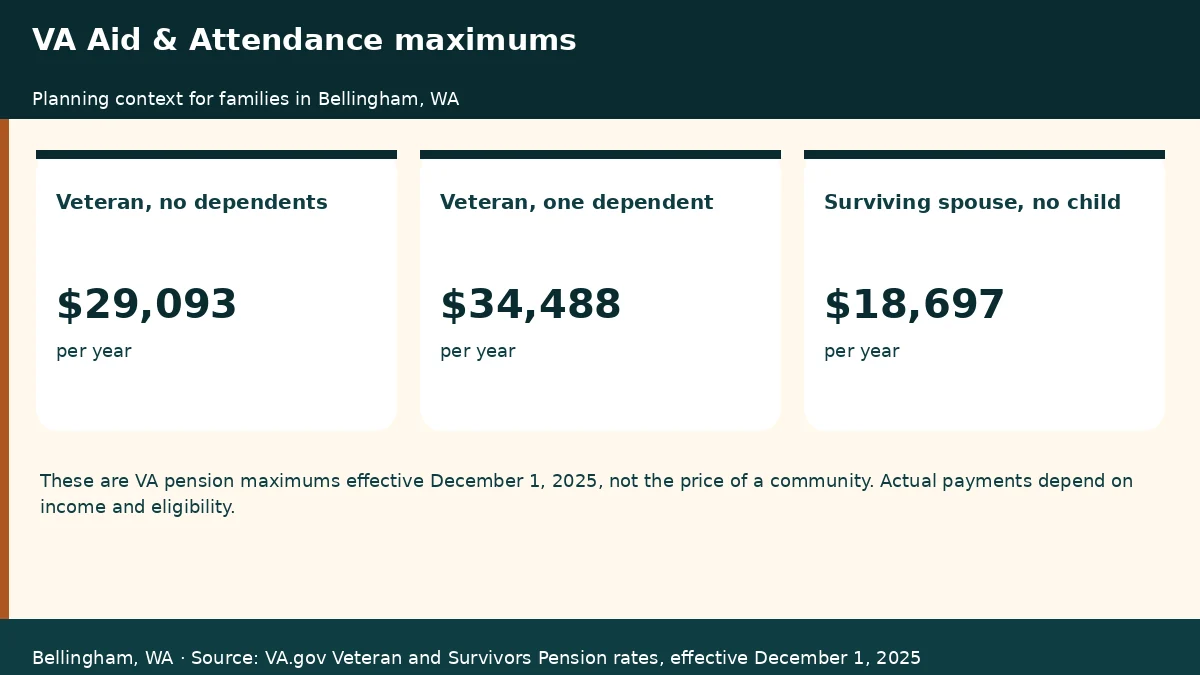
Eligible wartime Veterans and surviving spouses can review VA pension with Aid and Attendance. As of December 1, 2025, the maximum annual pension rate with Aid and Attendance is $29,093 for a Veteran with no dependents and $34,488 for a Veteran with one dependent (current VA pension rates). A surviving spouse’s Aid and Attendance maximum is $18,697 a year with no dependent children (VA Survivors Pension rates). These are benefit limits, not the price of a Bellingham community. The net worth limit for these pensions is $163,699 from December 1, 2025, through November 30, 2026.
For local public-benefit counseling, start with the federal Eldercare Locator at 1-800-677-1116, which connects families to the Area Agency on Aging that serves Bellingham, Washington.
When a parent in Bellingham is living with Alzheimer's disease or another dementia, care needs change in ways that are hard to plan for. Safety becomes a daily question. Evenings can be difficult. A family caregiver may be up several times a night. Memory care, whether in a dedicated dementia program or a small home with experienced caregivers, is designed for this stage, and it usually costs more than standard assisted living. This guide explains what the published data shows for Bellingham and how Washington families can plan.
What the published data shows
The survey does not have a memory care category, so there is no published memory care median for Bellingham or Washington from this source.
That is a national figure for one type of community, not a Bellingham price. It shows only that memory care tends to cost noticeably more. Ask each provider for a written quote.
Why memory care costs more
- More staff time. People with dementia often need step-by-step cueing or hands-on help with each part of the day.
- Supervision around the clock. Restlessness in the evening, night waking, and attempts to leave call for attentive caregivers at all hours.
- Training. Caregivers need skills in calm redirection and in understanding behavior as communication.
- A safer setting. Secured doors, simple layouts, and calm spaces reduce risk.
- Structured days. Routines and activities matched to each person's abilities.
Memory care offers support and a safer environment. It does not cure dementia or slow its course.
Memory care settings in Washington
Washington families generally see a few kinds of dementia care settings:
- Assisted living facilities with the Specialized Dementia Care Program. DSHS describes these as a facility dedicated solely to the care of people with Alzheimer's disease or dementia, or a designated, separate unit or wing for that purpose within a larger facility (DSHS, residential long-term care specialty contracts).
- Adult family homes. These licensed homes serve two to six residents, sometimes up to eight with approval, and some provide nursing or other special care (DSHS adult family home information sheet). Many families find that a small, quiet home with the same few caregivers each day suits a parent with dementia. Ask any home whether it serves residents with dementia and what training its caregivers have.
- Nursing homes, for people who also need daily skilled nursing.
Our guide to adult family homes versus assisted living in Bellingham compares the settings.
Signs memory care may be needed
- Wandering, or trying to leave home, especially in the evening
- Getting lost on familiar routes around Bellingham
- Unsafe use of the stove, car, or medications even with reminders
- Needing help with each step of dressing or bathing
- Growing anxiety or agitation late in the day
- Not recognizing danger, such as wet steps in the rainy months
Paying for memory care
- Private funds from income, savings, and home equity.
- Washington Medicaid can pay for long-term care services in licensed adult family homes and assisted living facilities that contract with the state, with the resident contributing part of their income (DSHS, Medicaid and long-term care services).
- VA benefits. Eligible veterans and surviving spouses may qualify for a VA pension with Aid and Attendance; the maximum annual rate for a veteran with no dependents is $29,093 for December 2025 through November 2026 (VA pension rates).
- Long-term care insurance often pays when cognitive impairment is documented.
See our guide to paying for long-term care in Bellingham.
Local help in Whatcom County
Northwest Regional Council is the Area Agency on Aging for Whatcom, Skagit, Island, and San Juan counties. Its Aging and Disability Resources staff offer information on in-home care, Medicaid, caregiver support, and long-term care options. In Whatcom County, call (360) 738-2500; the office is at 600 Lakeway Drive in Bellingham (Northwest Regional Council, Aging and Disability Resources).
Caring for the caregiver
Many Bellingham families care for a parent with dementia at home for years. It is devoted work, and it wears people down. Respite, adult day programs, and caregiver support can help. Northwest Regional Council lists caregiver support among its services. Choosing memory care is not giving up; for many families it brings steady support for a parent and lets relatives return to simply being family.
Concerns about care
If you have a concern about care in a Washington adult family home or assisted living facility, the DSHS Complaint Resolution Unit takes calls at 1-800-562-6078 (DSHS contact information).
Planning ahead
- Get a full medical evaluation; some causes of memory loss are treatable.
- Ask the doctor what supervision your parent is likely to need in the next year.
- Get written quotes from two or three settings.
- Ask how rates change as needs grow.
- Put powers of attorney and health care directives in place while your parent can take part.
Questions to ask about memory care pricing
- What does the monthly rate include?
- How are care needs assessed, and how often?
- What dementia training do caregivers have?
- How are doors secured?
- Do you accept Medicaid?
- What happens if my parent's needs exceed what you can provide?
About Gracious Living Adult Family Home
Gracious Living Adult Family Home is a small residential home at 1511 Edwards Street in Bellingham. Public listings have described its services differently, so please call (360) 746-2481 to confirm whether the home is currently accepting residents and what level of memory support it provides. You can also read our memory care page.
Frequently asked questions
How much does memory care cost in Bellingham, WA?
There is no published memory care median for Bellingham. Ask providers for written quotes.
How much more is memory care than assisted living?
There is no official federal or Washington private-pay median published for this type of care in Bellingham. Ask each community for a written quote after an assessment.
What is Washington's Specialized Dementia Care Program?
DSHS describes it as an assisted living facility, or a separate unit or wing within one, dedicated solely to caring for people with Alzheimer's disease or dementia.
Can an adult family home care for someone with dementia?
Many do. Adult family homes are licensed for two to six residents, and some provide nursing or special care. Ask each home about its experience and training.