
How Much Does Assisted Living Cost in Bellingham, Washington?
No federal or Washington agency publishes an official private-pay median for assisted living in Bellingham. The only reliable local number is a written quote after a community assesses the apartment and the help a person needs.
Medicare does not pay for room, board, or ongoing custodial care in assisted living if that is the only care someone needs (Medicare.gov: long-term care coverage).
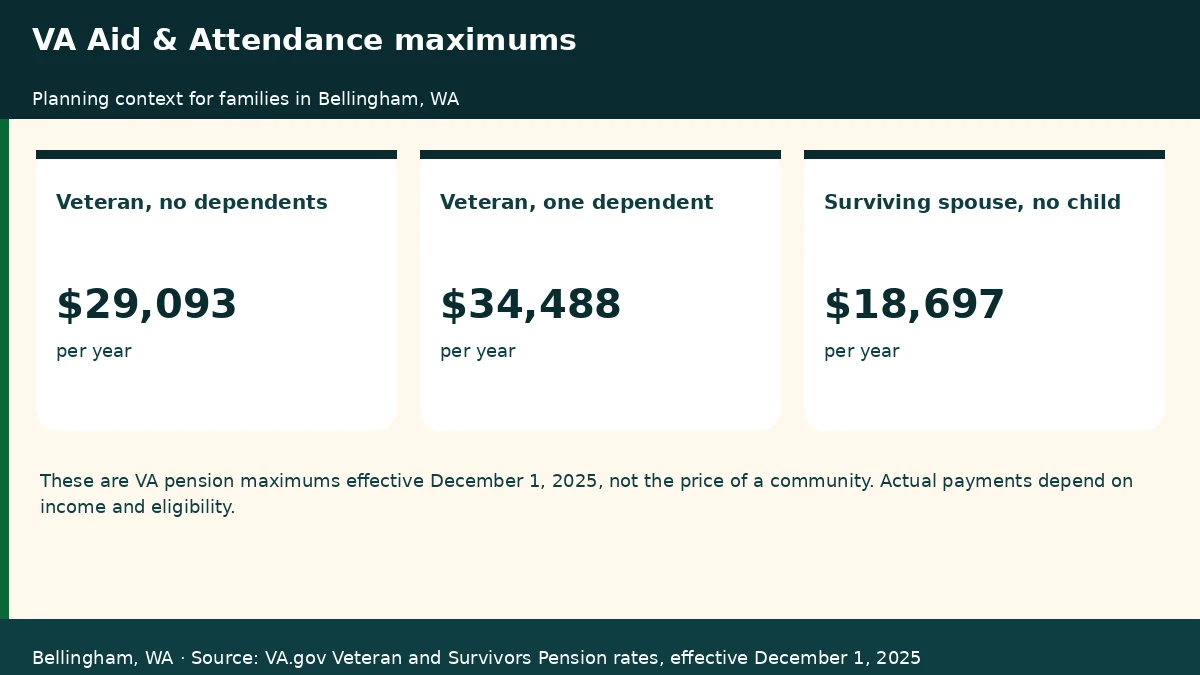
Eligible wartime Veterans and surviving spouses can review VA pension with Aid and Attendance. As of December 1, 2025, the maximum annual pension rate with Aid and Attendance is $29,093 for a Veteran with no dependents and $34,488 for a Veteran with one dependent (current VA pension rates). A surviving spouse’s Aid and Attendance maximum is $18,697 a year with no dependent children (VA Survivors Pension rates). These are benefit limits, not the price of a Bellingham community. The net worth limit for these pensions is $163,699 from December 1, 2025, through November 30, 2026.
For local public-benefit counseling, start with the federal Eldercare Locator at 1-800-677-1116, which connects families to the Area Agency on Aging that serves Bellingham, Washington.
For families in Bellingham, finding care for an aging parent often starts with one practical question: what will it cost? Washington is one of the more expensive states for senior care, and Whatcom County is no exception. But the published numbers also hold a few surprises, including how the cost of home care compares with living in a care setting.
What official figures can and cannot tell Bellingham families
Bellingham has its own metro area in the survey.
A median is not a price
A median is the midpoint of the providers surveyed. Half charge more, half less. Use them as a benchmark, and ask each provider for its current rates in writing.
Where adult family homes fit
In Washington, many families consider an adult family home as well as a larger assisted living facility. An adult family home is a residential house licensed to provide room, meals, laundry, supervision, and help with daily activities for two to six adults, and some homes provide nursing or other special care (DSHS adult family home information sheet). Homes licensed for at least two years may apply to serve up to eight residents if they meet certain criteria.
Rates vary widely depending on the home, the room, and the care a resident needs. Our guide to adult family homes versus assisted living in Bellingham explains the differences.
The home care comparison
For a parent who needs many hours of help, a residential setting may be the more affordable choice. See our comparison of assisted living and in-home care costs in Bellingham.
What shapes an individual quote
The room
Private and shared rooms, room size, and a private bathroom all affect the rate.
The level of care
Most providers assess each new resident and set a rate based on the help needed with bathing, dressing, toileting, mobility, and medications. In many settings the care portion of the rate rises as needs grow.
Memory and behavior support
Residents living with dementia usually need more supervision and staff time. See our guide to memory care costs in Bellingham.
What is included
Ask whether meals, laundry, housekeeping, medication help, transportation, and activities are included, or billed separately.
What residential care usually includes
- A private or shared room
- Home-cooked or prepared meals and snacks
- Help with personal care
- Medication assistance
- Laundry and housekeeping
- Activities and social time
- Supervision around the clock
A simple budgeting method
- Add up monthly income: Social Security, pensions, and annuities.
- List savings and assets, including the value of a home.
- Subtract income from expected cost to find the monthly gap.
- Divide savings by the gap to see how long they last.
- Leave room for rate increases and growing needs.
For example, a retired teacher with $3,200 a month in pension and Social Security, considering a setting near the $6,650 median, would face a gap of about $3,450 a month.
Help with paying
Washington Medicaid can pay for long-term care services in a licensed adult family home or assisted living facility that contracts with the state, with the resident contributing toward the cost from their income (DSHS, Medicaid and long-term care services for adults). Our guide to paying for long-term care in Bellingham explains the options.
Comparing quotes fairly
When you have quotes from two or three providers, set them side by side. Include the base rate, the care charge for your parent's likely needs, any one-time fees, and the extras your parent would use. A higher base rate that includes medication help and laundry may cost less overall than a lower one with many add-ons. Ask how often rates have increased and how much notice is given.
Start early
Families who look before a crisis have time to compare, involve their parent, and line up benefits such as Medicaid or VA support, which can take months. A fall or hospital stay at PeaceHealth St. Joseph can force a decision in days. A few early phone calls and visits make that moment far less stressful.
Questions to ask for an accurate quote
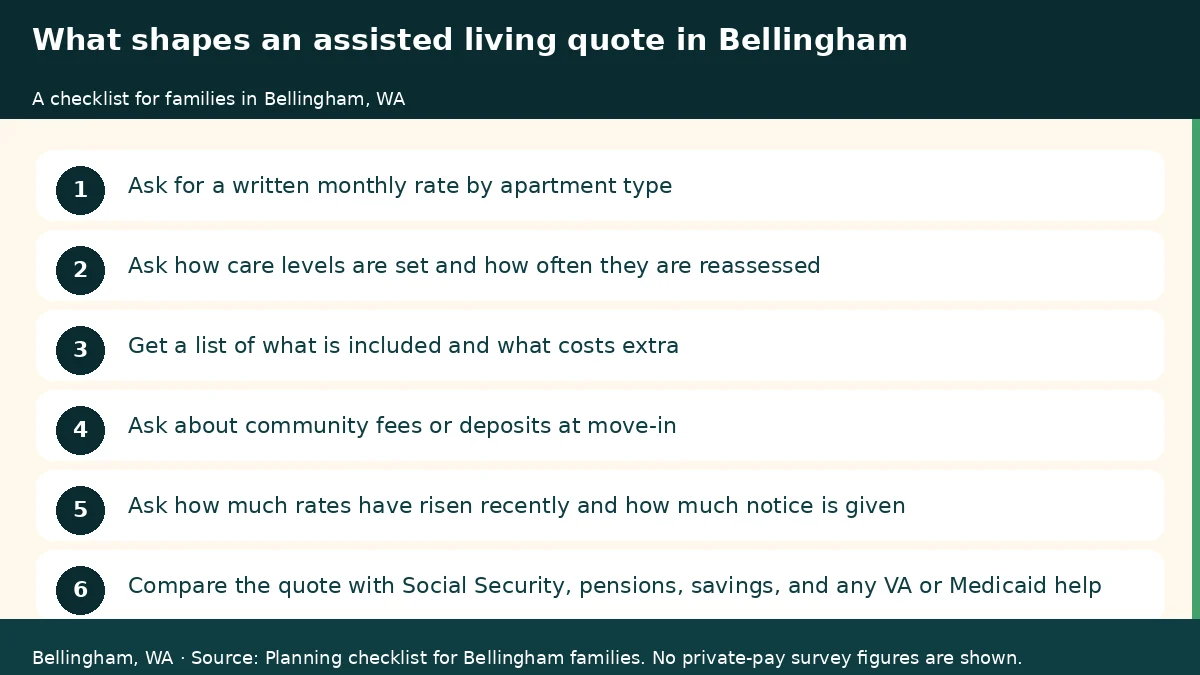
- What is the monthly rate for each room type?
- How do you assess care needs, and how does that change the rate?
- What is not included?
- Are there move-in fees or deposits?
- Do you accept Medicaid, and do you have a Medicaid contract with the state?
- How much notice do you give before raising rates?
About Gracious Living Adult Family Home
Gracious Living Adult Family Home is a small residential home at 1511 Edwards Street in Bellingham. Please call (360) 746-2481 to confirm whether the home is currently accepting residents and to ask about current rates, or visit our contact page.
Frequently asked questions
How much does assisted living cost in Bellingham, WA?
Individual providers may charge more or less.
Is Bellingham cheaper than the Washington average?
Yes.
How much does an adult family home cost in Bellingham?
Rates vary by home and care needs, so ask each home for a written quote.
Does Washington Medicaid pay for adult family homes?
Washington Medicaid can pay for long-term care services in licensed adult family homes and assisted living facilities that contract with the state. Residents may contribute part of their income.